
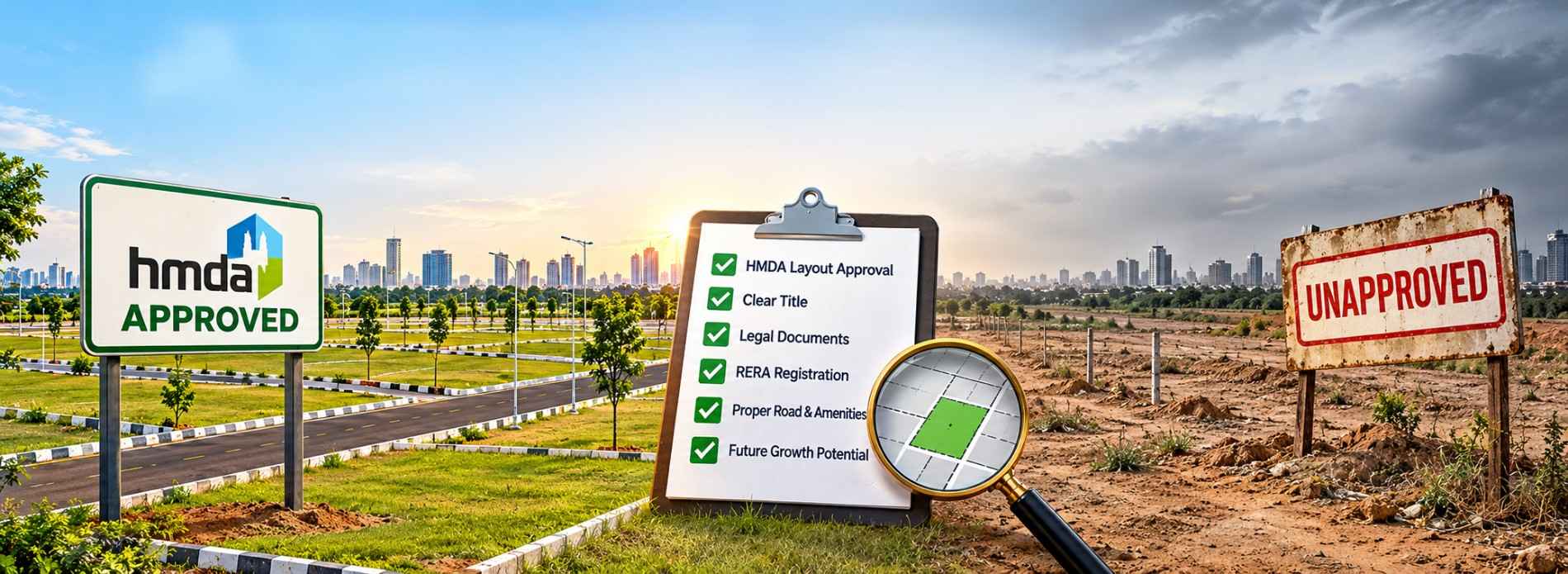
HMDA-Approved vs. Unapproved Plots: What Every Buyer Must Check Before Investing
Buying a residential plot in Hyderabad can be an important financial decision. Whether you plan to construct a home or hold the property as a long-term investment, verifying the legal status of the layout is one of the most important steps before making a purchase.
Many buyers compare properties based on price, location, amenities, and future development potential. However, overlooking planning approvals and ownership documents can lead to complications later. Understanding the difference between HMDA-approved and unapproved layouts can help buyers make more informed decisions.
1. What Is an HMDA-Approved Plot?
The Hyderabad Metropolitan Development Authority (HMDA) is a planning authority responsible for development planning and permissions within its applicable jurisdiction.
An HMDA-approved layout has received the relevant layout approval from HMDA, subject to the conditions specified in the approval proceedings. Such approval establishes that the layout has undergone the applicable planning process.
However, layout approval does not automatically establish clear ownership of every plot or guarantee that all development work has been completed. Buyers must independently verify the seller’s title, the specific plot details, and compliance with applicable approval conditions.
It is also important to establish which planning authority has jurisdiction over the property. Not every plot marketed as being in Hyderabad requires HMDA approval.
2. What Is an Unapproved Layout?
An unapproved layout is one that has not obtained the required approval from the competent planning authority.
Such layouts may be marketed at attractive prices, but buyers should understand the associated risks before proceeding. Depending on the property’s location and circumstances, the lack of approval may create difficulties with building permissions, financing, resale, infrastructure provision, or future regularisation.
A seller’s promise that approval will be obtained later is not equivalent to an existing valid approval.
Buyers should never assume that an unapproved layout will automatically qualify for regularisation. Eligibility depends on the applicable rules, the land’s status, and the decision of the relevant authority.
3. Key Differences Between Approved and Unapproved Layouts
Planning permission
An approved layout has the applicable sanctioned permission, subject to its conditions. An unapproved layout lacks the required permission, which can create uncertainty about the property’s lawful development.
Construction permissions
A properly approved layout provides a clearer planning basis for seeking building permission. Construction is still subject to applicable rules, plot-specific restrictions, and the required approvals.
An unapproved layout may face additional obstacles or restrictions.
Legal verification
Both approved and unapproved properties require title verification. Planning approval does not automatically prove that the seller has the legal right to sell the land.
Infrastructure and layout planning
An approved layout may specify roads, open spaces, and other planning provisions. Buyers should still inspect the actual site to confirm the development status and verify compliance with the sanctioned plan.
Financing and resale
Lenders and prospective buyers may scrutinise unapproved properties more closely. An approved layout may provide greater clarity, but neither loan approval nor future resale value is guaranteed.
4. How to Verify HMDA Layout Approval
Buyers should not rely solely on brochures, screenshots, or approval numbers supplied by a salesperson.
Follow these steps:
- Obtain the complete approval proceedings and sanctioned layout plan.
- Identify the planning authority responsible for the property’s exact location.
- Verify the approval details through the authority’s official records.
- Confirm whether the approval is draft or final and review any conditions.
- Compare the approved plan with the actual site, including plot numbers, boundaries, roads, and open spaces.
- Check whether any conditions, mortgage requirements, or outstanding compliance matters affect the specific plot.
These checks help establish whether the property being offered matches the approved layout.
5. Verify Ownership and Title Documents
Layout approval and land ownership are separate matters. Buyers must confirm that the seller has a valid and transferable title.
Request the current title deed, parent documents, and link documents that establish the chain of ownership. Have an independent property lawyer review these records to identify potential ownership disputes or inconsistencies.
The review should also consider encumbrance records, registered mortgages, relevant court cases, claims, and other matters affecting the property.
An encumbrance certificate is useful, but it does not necessarily reveal every possible legal issue. It should form part of a wider legal review.
6. Check Land Use and Telangana RERA Registration
Confirm that the land is legally suitable for the intended residential use. Depending on the property, this may require reviewing land classification, revenue records, survey details, conversion permissions, and applicable restrictions.
Also check whether the plotted development requires registration under the Real Estate (Regulation and Development) Act and applicable Telangana RERA rules. Where registration is required, verify the project’s details through the official Telangana RERA portal.
RERA registration does not replace title verification or the need to confirm planning approvals.
7. Inspect the Site Before Investing
A property may look attractive in a brochure, but a physical inspection provides valuable information about its actual condition.
Check road access, drainage, electricity, water arrangements, plot boundaries, surrounding development, and access to essential services. Ask for written details of promised amenities, maintenance arrangements, and development commitments.
If the project is still under development, clarify which facilities are operational and which remain pending.
8. Common Mistakes Buyers Should Avoid
Buyers should avoid selecting a plot solely because it is inexpensive, accepting unverified approval numbers, or assuming that future regularisation is guaranteed.
Do not pay a substantial advance before independently checking the title and layout approval. Equally, do not assume that a property is legally clear simply because it is advertised as approved.
Taking time to verify the documentation can help reduce the risk of expensive disputes and delays.
Conclusion
Understanding the difference between HMDA-approved and unapproved layouts is essential when purchasing residential land in Hyderabad. Proper verification of planning permissions, ownership documents, land use, and development conditions helps buyers make decisions with greater confidence.
Sikharagra encourages informed property decisions by allowing prospective buyers to explore residential developments and review project information before taking the next step. Visit https://sikharagra.com/ to explore available projects and enquire about residential plot opportunities.